
Probably the biggest concern we hear on the public stage regarding the emerging technologies of AI research is the threat it poses to American jobs. While many of our lawmakers seem willfully unconcerned or unaware of the purported fallout of this phenomenon – or perhaps just unconvinced that it’s an issue that they will need to deal with during the current election cycle – the Interwebs are teeming with opinion pieces on the development of artificial intelligence and robotics as a tool in the workforce. And while I’m sure you can find the edge case that claims the alarm bells are wholly unjustified, most of the social ecology seems to agree that the issue is real – just not to what depth it requires our attention.
I always find it particularly interesting because I was automated out of a job in 2010, effectively ending my career in radio after 15 years. Then it happened again in 2013 when the technology at USPS advanced to the point where they could close down that big-ass remote encoding center in south Wichita (though we were fortunate enough with the union contracts that they took extra steps to help find us alternative positions). This isn’t a new problem; it’s just never been as omnipresent as it’s about to be.
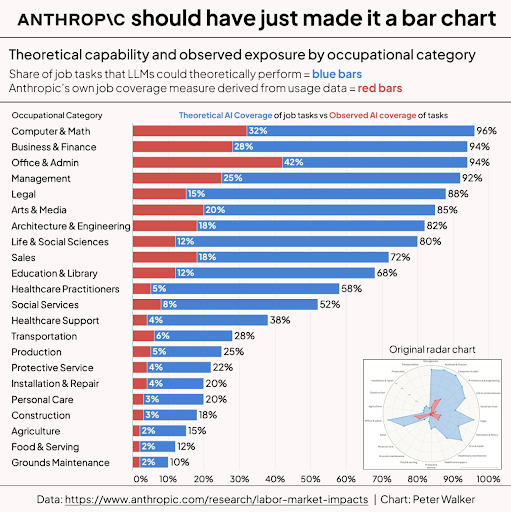
While robotics have steadily advanced to help large-scale industrial manufacturers slim down their workforce over the past couple decades, replacement of white collar jobs has been less visible. With the tools currently in development, that’s about to change. As of right now, AI can theoretically cover most tasks in business and finance, management, computer science, math, legal, and office administration roles. In most sectors, actual adoption has not reflected this theoretical capability. Reliable prediction models now suggest, however, that most professional positions will be effectively eliminated in the next year to 18 months.
18 months. You read that right.
Over the past year or so, I’ve been on the lookout for job opportunities commensurate with my background and skills. I have a strong resume, and I interview well, but the competition for management jobs in every sector in steep. In recent months, my wife has also joined the search. With a strong accounting background, she’s had more opportunities roll her way, but the results are similar (thus far; she has a couple of really good prospects in play as I write this, so here’s hoping it’ll turn around). As challenging as it is for experienced talent to find decent jobs in the current market, entry level applicants are facing a veritable desert contrasted with just a decade ago.
A report out of Anthropic throws this into fantastic perspective, measuring their observations of current AI job coverage in different sectors of the market based on what they know their LLM project Claude is capable of handling (Angelo, 2026).
While layoffs are inevitable, the lack of new opportunities is a critical concern. At 50 years of age, my career is significantly in the rearview mirror. I have skills that will likely get me something lucrative in the days ahead, as I nudge out other equally-qualified applicants who don’t fit some hiring managers image of an ideal candidate, but I can’t expect to get comfortable. I’ve been involved in some pretty hefty change management situations in the past, and I have a sense that the disruption represented by AI innovation will shake up the market in ways that will keep me on my toes for years to come – and ultimately drum me right back onto the street.
While the implications are potentially ludicrous in scope, like most Americans I can really only concentrate on my own domain. This fall I decided to tackle yet another graduate degree with an eye toward advancing my career in the field of project management, but now I’m starting to wonder whether it’s a realistic pursuit. I’m not abandoning the prospect just yet; at the very least, I’m learning a lot about a discipline that is applicable to the business world in a very broad sense. But I have some decisions to make.

And that’s my takeaway. Jonikka and I have a 5-year plan, which starts as soon as we’re back in a cash-saving motif with our collective employment situation, that is geared toward crafting the life we want in the years now and retirement. It’s a good plan, and it’s adaptable if the situation changes – so long as we can avoid plunging back into a sitch that eats up our savings before we have a chance to seriously invest in our future. Ultimately, I’ve had to make wrestle with some important realizations and figure out how to embrace the future with all of its uncertainty, lest we be left spinning out without a Colonel Sanders to reach for the brake.
Damn, That’s a pull.
This is only one way that AI development affects both our current paradigm and our future opportunities, and some of the assumptions laced into this approach kind of ignore some big-picture eventualities. I think I’ll back up and take a running jump at the rabbit hole the other side of those eventualities in my next article, before we move away from strictly focusing on the job market and start running headlong into the craziness beyond.
Angelo, J. (2026, March 6). Anthropic just mapped out which jobs AI could potentially replace. A “Great Recession for white-collar workers” is absolutely possible | Fortune. Fortune. https://fortune.com/2026/03/06/ai-job-losses-report-anthropic-research-great-recession-for-white-collar-workers/